
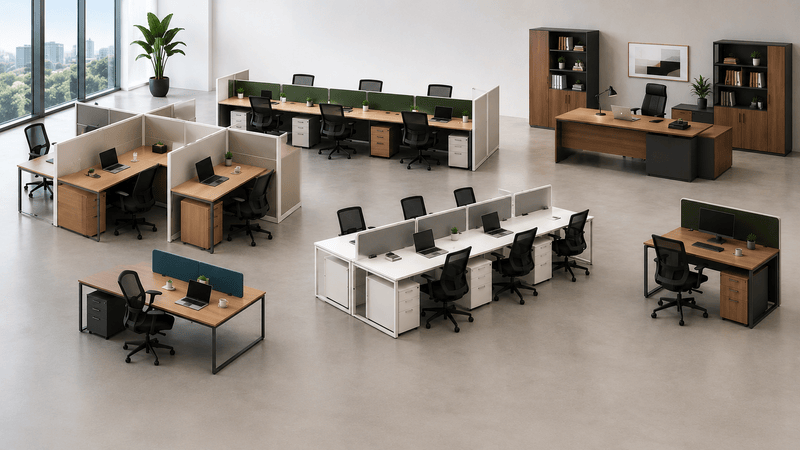
Office Workstation Price in Kenya
What Is The Current Office Workstation Price In Kenya?
The office workstation price in Kenya in 2026 ranges from KES 15,000 per person for a basic open-plan position to over KES 100,000 per person for a premium cubicle workstation with privacy screens, integrated storage, and ergonomic accessories. Most Kenyan SMEs spend between KES 25,000 and KES 45,000 per workstation — a price band that delivers durability, basic privacy, and adequate storage.
Workstations are the foundation of any modern Kenyan office. Choosing the right configuration affects floor space efficiency, employee productivity, collaboration patterns, and total furniture spend. This guide breaks down every workstation type and tier so you can make an informed decision.
Office Workstation Price Kenya: Breakdown By Type
Linear Workstations (KES 15,000 – KES 28,000 per person)
Linear workstations are rows of back-to-back or single-row desks separated by privacy screens. They’re the cheapest workstation type and use floor space efficiently. Typical specifications include 1.2m × 0.6m work surface, 1m-high fabric or melamine privacy screen, and a small under-desk pedestal.
Cluster Workstations — 4 Person (KES 22,000 – KES 38,000 per person)
Cluster workstations arrange 4 people around a central hub, separated by privacy screens. They balance collaboration and individual focus, making them popular for teams that work together regularly. Each position typically gets 1.4m × 0.7m of desk space and a half-height privacy screen.
Cluster Workstations — 6 Person (KES 65,000 – KES 92,000 per person)
Six-person cluster workstations maximize floor space utilization while maintaining team identity. They’re popular in call centres, customer service teams, and operations departments. The central hub often includes shared printer/scanner spaces and cable distribution points.
Cubicle Workstations (KES 45,000 – KES 80,000 per person)
Cubicle workstations provide the most privacy in an open office. Each cubicle features three walls (1.4m – 1.6m high), an L-shaped desk surface, overhead storage cabinets, and an under-desk pedestal. They suit roles requiring focused work, calls, and confidential conversations.
Premium Cubicle Workstations (KES 75,000 – KES 100,000+ per person)
Premium cubicles include sit-stand desk surfaces, full-glass privacy panels, integrated power and data, task lighting, and acoustic panels. They suit knowledge workers, finance teams, legal teams, and any role where focused 8+ hour work is the norm.
Office Workstation Price Kenya Comparison Table
| Workstation Type | Price Per Person (KES) | Floor Space Per Person | Best For |
| Linear (back-to-back) | 15,000 – 28,000 | 3.5 – 4.5 sqm | Call centres, data entry |
| 4-Person Cluster | 22,000 – 38,000 | 4.5 – 5.5 sqm | Collaborative teams |
| 6-Person Cluster | 25,000 – 42,000 | 4.0 – 5.0 sqm | Operations, customer service |
| Cubicle | 45,000 – 80,000 | 6.0 – 7.5 sqm | Focus work, confidential roles |
| Premium Cubicle | 75,000 – 100,000+ | 7.0 – 9.0 sqm | Knowledge workers, finance |
What Drives Office Workstation Prices In Kenya?
1. Desktop Material
MDF with melamine finish is the standard for budget workstations. PVC laminate offers better edge durability at a small premium. Real wood veneer (25–40% premium) elevates aesthetics. Premium workstations sometimes use thermofused laminate, which closely mimics wood and resists wear better than melamine.
2. Privacy Screen Type
Half-height fabric screens (1m – 1.1m) are the cheapest and most common. Full-height screens (1.4m – 1.6m) add KES 4,000 – KES 12,000 per workstation. Glass-topped screens cost more but improve light penetration and prevent the office from feeling like a maze.
3. Storage Configuration
Mobile pedestals (3-drawer storage on castors) are standard at all tiers. Overhead storage cabinets (KES 8,000 – KES 18,000 per workstation) free up desk space significantly. Wall-mounted shelves are budget alternatives that work well in cluster configurations.
4. Cable Management
Basic workstations rely on cable trays under desks. Quality workstations include vertical cable spines connecting the desk to the floor, with managed routing for power, data, and phone. Premium workstations feature integrated power and USB outlets at desk level, eliminating exposed cables entirely.
5. Adjustability
Fixed-height workstations are standard. Adjustable-height workstations (where each user can raise or lower their desk) add KES 8,000 – KES 35,000 per position. Full sit-stand workstations add KES 25,000 – KES 60,000 but deliver real productivity and health benefits for 8+ hour daily workers.
How Many Workstations Fit In Your Office Space?
Plan 4–5 square metres per linear workstation, 4.5–5.5 square metres per cluster position, and 6–7.5 square metres per cubicle. These figures include the work area plus aisles, breakout corridors, and emergency exit clearances. Always allow 25–35% additional floor area for circulation, meeting rooms, kitchen, washrooms, and storage — never plan workstations to fill every available square metre.
Office Workstation Price Kenya: Bulk Order Savings
Workstations offer significant economies of scale. Orders of 10+ workstations typically attract 12–20% discounts off unit prices. Orders of 50+ unlock further discounts of 18–30% and often include free space planning, delivery, and assembly. The largest Kenyan suppliers can deliver and install 100+ workstations within 4 weeks of order.
Choosing Between Workstations And Individual Desks
For teams of 8 or more performing similar work, workstations are almost always more cost-effective than individual desks. They save 25–40% on total cost, use floor space more efficiently, and include built-in cable management and privacy. Individual desks suit small teams, executive areas, or layouts that need to be reconfigured frequently. Workstations win on cost; individual desks win on flexibility.
Final Thoughts On Office Workstation Prices In Kenya
Workstations are one of the most cost-effective ways to furnish a growing office in Kenya. The office workstation price in Kenya offers excellent value at every tier, but the cluster workstation segment (KES 25,000 – KES 38,000 per person) consistently delivers the best balance of cost, comfort, and team productivity for most Kenyan SMEs.
Invest a little more in premium ergonomic chairs to pair with workstations — the combination of a quality workstation and a quality chair determines daily comfort and long-term productivity. Pair smart workstation choices with thoughtful chair selection, and you’ve built the foundation of a productive Kenyan office.
Frequently asked questions
What is the cheapest office workstation price in Kenya?
The cheapest office workstations in Kenya start at around KES 15,000 per person for a basic linear back-to-back configuration with 1.2m desk, half-height fabric screen, and small mobile pedestal. Below this price, you’ll typically be looking at standalone desks rather than true workstation systems.
How much does a 4-person workstation cost in Kenya?
A 4-person cluster workstation in Kenya costs between KES 88,000 and KES 152,000 total (KES 22,000 – KES 38,000 per person). This includes 4 desk positions, privacy screens, mobile pedestals, and cable management. Add KES 15,000 – KES 25,000 per chair for complete setup.
What’s the difference between a workstation and an office desk?
Workstations are integrated systems combining desk, privacy screens, storage, and cable management designed for groups (4, 6, 8 or more positions). Individual desks are standalone furniture without integrated screens or storage. Workstations cost 25–40% less per person for groups but offer less flexibility than individual desks.
Are open-plan workstations better than cubicles?
Neither is universally better — they suit different work styles. Open plan (linear and cluster) promotes collaboration, uses floor space efficiently, and costs less. Cubicles provide focus, privacy, and acoustic separation but cost 50–100% more and use more floor space. Most Kenyan offices benefit from a mix: open plan for collaborative roles, cubicles for focused work.
How much floor space does each workstation need?
Linear workstations need 3.5 – 4.5 square metres per person. Cluster workstations need 4.5 – 5.5 square metres. Cubicles need 6 – 7.5 square metres. Add 25–35% for circulation, meeting rooms, and shared spaces when calculating total office floor space requirements.
Can I get workstations with sit-stand desks in Kenya?
Yes — sit-stand workstations are increasingly available in Kenya, priced at KES 50,000 – KES 100,000 per position. Electric height-adjustable workstations are best for daily use; manual crank versions are cheaper but discourage frequent position changes. Sit-stand workstations pay back through reduced back pain and improved focus.
How long does workstation delivery and installation take in Kenya?
Standard off-the-shelf workstations we deliver in 1–2 days within Nairobi. Custom configurations take 4–8 days. Installation for a 10-person office typically takes 1–2 days; 50-person offices take 5–10 days. Larger projects require coordination with electrical and data contractors.
Do workstations in Kenya come with privacy screens included?
Quality workstations include privacy screens as standard. Cheap workstations sometimes omit screens to advertise lower prices, then charge extra. Always confirm in writing whether screens are included, what height they are, and what material (fabric, melamine, or glass) is used.
What’s the best workstation type for a call centre in Kenya?
Linear back-to-back workstations work best for call centres — they’re cheapest, use floor space efficiently, and the fabric privacy screens provide useful acoustic absorption. Add quality task chairs (KES 14,000+) and headsets. Avoid open clusters in call centres, as the noise from one cluster bleeds into adjacent clusters.
How long do office workstations last in Kenya?
Budget workstations (KES 15,000 – KES 22,000 per person) last 4–7 years before requiring replacement. Mid-range workstations (KES 25,000 – KES 38,000) last 8–12 years. Premium workstations (KES 50,000+) last 12–20 years and components can usually be reconfigured rather than replaced.
Can workstations be reconfigured later if my team grows or changes?
Modular workstations from established Kenyan manufacturers are designed for reconfiguration — you can add positions to a cluster, swap privacy screens, or rearrange entire layouts. Cheap workstations are often glued or fixed-built, limiting future flexibility. Always ask about reconfiguration when ordering — it determines long-term value.
Should workstations include personal storage in Kenya?
Yes — at minimum, each workstation should include a 3-drawer mobile pedestal (KES 12,000 – KES 22,000). For paper-heavy roles, add overhead cabinets or a 2-drawer filing pedestal. Workers without dedicated storage end up cluttering desks with papers, which hurts productivity and looks unprofessional.
What chairs work best with office workstations in Kenya?
Mid-range mesh ergonomic chairs (KES 14,500 – KES 25,000) pair best with workstations for general staff. Match chair quality to expected hours of use — knowledge workers spending 8+ hours daily justify premium ergonomic chairs (KES 35,000+). Avoid pairing premium workstations with cheap chairs; the chair determines daily comfort more than the desk does.
Are imported workstations better than locally made workstations in Kenya?
Locally made workstations from established Kenyan manufacturers offer 80–90% of the quality of imported workstations at 40–60% lower prices. Imported workstations (typically from China, Turkey, or Europe) offer marginally better hardware and finishes. For most Kenyan businesses, locally made workstations deliver the best total value.